
A psychiatric evaluation is a medical investigation into what is driving your mental health symptoms and get a treatment plan tailored to your brain and body. If you are in Las Vegas tired of generic advice, lingering symptoms, or prescriptions that leave you feeling numb, a thorough evaluation is how you get real answers.
Most people do not book a psychiatric evaluation because things are going smoothly. Usually, you reach this point after months—or years—of trying to push through brain fog, sudden irritability, exhaustion, or racing thoughts that therapy or willpower alone cannot fix. Most people do not book a psychiatric evaluation because things are going smoothly. Usually, you reach this point after months—or years—of trying to push through brain fog, sudden irritability, exhaustion, or racing thoughts that therapy or willpower alone cannot fix. A psychiatric evaluation is designed to give you those real answers and help you figure out your best next step—whether that includes medication management, targeted therapy, or a combination of both.
What Is a Psychiatric Evaluation?
A psychiatric evaluation is a diagnostic medical appointment with a psychiatric provider—either a psychiatrist or a psychiatric mental health nurse practitioner (PMHNP)—that separates overlapping symptoms to identify the true root cause. Because conditions like adult ADHD, generalized anxiety, bipolar spectrum disorders, PTSD, and even thyroid or sleep issues look nearly identical on the surface, treating the wrong one often makes you feel worse.
According to the National Institute of Mental Health (NIMH), an accurate diagnosis is the foundation of effective mental health care because different conditions require completely different treatments. During your evaluation, your provider connects your medical history, symptom timeline, and daily biology to determine whether medication management (selecting, monitoring, and adjusting psychiatric medications safely), targeted therapy, lab testing, or a combination of approaches makes the most sense for you.
What Is the Difference Between a Psychiatrist and a Psychiatric Nurse Practitioner?
Both are licensed medical providers trained to diagnose mental health conditions and prescribe medication. A psychiatrist is a medical doctor (MD or DO), while a psychiatric mental health nurse practitioner (PMHNP) is an advanced practice nurse with specialized graduate training in psychiatric care.
At Insight Therapy Solutions, our psychiatric evaluations and medication management are led by licensed Psychiatric Mental Health Nurse Practitioners (PMHNPs) who work closely with our therapy team to support you. In day-to-day care, you get the same thorough diagnostic evaluation and full prescription options, paired with a holistic, patient-centered approach where your provider takes the full session to understand your history and build your care plan.
Should You Start With Talk Therapy or a Psychiatric Evaluation?
You should start with a psychiatric evaluation when your symptoms are interfering with basic functioning—like sleeping, working, or concentrating—when you suspect an underlying condition like ADHD or bipolar disorder, or when you have been in therapy for months without real relief. Therapy and psychiatry solve two completely different problems.
| What You Are Dealing With | Talk Therapy | Psychiatric Evaluation & Care |
| The Core Problem | Unresolved trauma, relationship stress, thought patterns, and coping habits | Chemical imbalances, neurological conditions, severe mood shifts, or chronic symptoms |
| What Happens in Care | You build behavioral skills and process emotions over regular sessions | You get a medical diagnosis, rule out physical triggers, and explore targeted medication |
| Who Treats You | Licensed therapist, counselor, or psychologist | Psychiatrist or psychiatric mental health nurse practitioner (PMHNP) |
| Time Commitment | Weekly or biweekly 50-minute sessions | One deep-dive initial evaluation, followed by brief monthly or quarterly check-ins |
If you are trying to talk your way out of a biological issue—like severe clinical depression or undiagnosed ADHD—therapy alone will feel like trying to run with a sprained ankle. Combining psychiatric care to stabilize your baseline with therapy to build lasting habits is often what finally breaks the cycle.
What Happens During Your First Appointment?
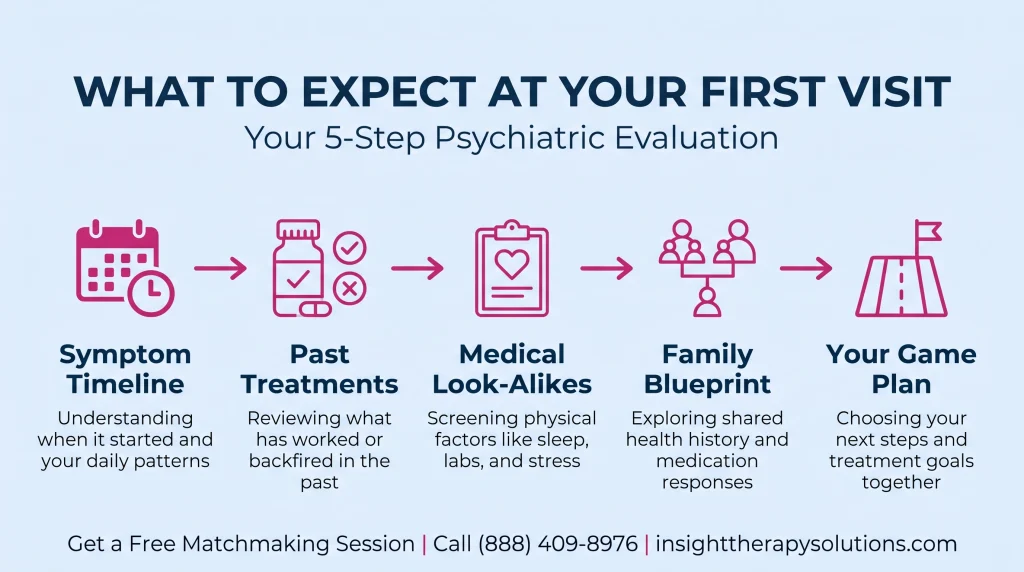
A thorough evaluation looks much more like a detective conversation than an interrogation. Instead of running down a rigid checklist, your provider looks for patterns across five key areas:
- Your Symptom Timeline (Not Just Today’s Mood): You will look at when your symptoms first appeared, what makes them spike, and whether they come in cycles—crucial clues that prevent common misdiagnoses.
- What Has Backfired in the Past: If an antidepressant made you feel wired, exhausted, or emotionally flat in the past, that is valuable clinical data. Your provider reviews past medications to see what your body rejected and why.
- Medical Look-Alikes: Vitamin deficiencies, hormonal shifts, sleep apnea, and chronic stress routinely masquerade as anxiety or depression. Your provider screens for physical red flags and may recommend basic blood work before jumping to conclusions.
- Family Blueprint: Mental health conditions and medication responses often run in families; knowing what worked (or failed) for a close relative can save you months of trial and error.
- A Practical Game Plan: Before you leave, your provider explains what they see in plain language—no hidden notes or vague labels—and outlines specific options, including expected timelines, potential side effects, and how you will track progress.
How Long Does a Psychiatric Evaluation Take?
Most initial evaluations last between 45 and 60 minutes. That window is intentional: it takes real time to untangle years of symptoms, medical history, and past treatments without cutting you off mid-sentence.
Follow-up visits are usually shorter, around 15 to 30 minutes. Once you have a clear plan, those check-ins focus on fine-tuning doses, catching side effects early, and making sure your treatment keeps up with your life.
How Should You Prepare So You Do Not Waste Your Visit?
Walking in prepared ensures your provider gets the exact data they need to help you right away, rather than spending half the session guessing names and dates.
- Bring the Exact Names of Past Medications: Knowing that “a blue pill made me dizzy three years ago” is far less helpful than knowing the exact drug name and dose; check your old pharmacy app or portal beforehand.
- List Every Supplement and Caffeine/Alcohol Habit: Pre-workout powders, melatonin, herbal blends, and energy drinks directly interact with psychiatric medications and sleep architecture.
- Track Your Top Three Disruptions: Instead of trying to describe everything at once, write down the three specific moments in your week where symptoms hit hardest (for example, “I cannot shut my brain off between 11 PM and 2 AM”).
- Be Honest About Your Dealbreakers: Tell your provider upfront if weight gain, brain fog, sexual side effects, or taking multiple pills is a hard no for you—good prescribing starts with your boundaries.
How Insight Therapy Solutions Can Help
Insight Therapy Solutions (ITS) is a mental health practice in Las Vegas, Nevada, offering both in-person and online telehealth sessions for psychiatric services, medication management, and talk therapy for adults. Our trauma-informed, LGBTQ+ affirming providers take the time to investigate the full picture, explain every option clearly, and coordinate your psychiatric care directly with your therapist so nothing falls through the cracks.
Whether you prefer coming into our Las Vegas office face-to-face or meeting from home via secure online sessions anywhere in Nevada, you can start with a free matchmaking session where you tell us what you are dealing with, what you need, and your preferences. During that conversation, our care team will listen to your goals, verify your Nevada insurance benefits upfront, and connect you with the right provider.
Get a Free Matchmaking Session — or call us directly at (888) 409-8976 to get started.
