
You’re scrolling through social media, and every post shows families laughing around perfectly set tables, couples exchanging meaningful gifts, friends raising champagne glasses at midnight. Meanwhile, you’re wondering how you’ll survive dinner when there’s an empty chair at the table.
The hardest part of navigating major life transitions during the holidays isn’t the day itself. It’s the pressure to act like everything is fine when your entire world has shifted.
Whether you’re facing your first holiday season after losing someone you love, adjusting to divorce, relocating far from everything familiar, or experiencing any significant change, you’ve probably noticed something: those traditions you used to cherish now feel hollow, simply impossible to maintain.
This guide offers clinical strategies that work, real approaches therapists use with clients navigating grief, divorce, loss, and major life changes during the holiday season.
Why Major Life Transitions Hit Harder During the Holidays
Think about the last time you heard a holiday song that immediately transported you back to a specific memory. That instant emotional reaction happens because our brains are wired to associate this season with powerful emotional memories and expectations built over decades and when you’re going through an adjustment period, these memory anchors can feel like weights pulling you under.
That’s also why many people experience December questioning—a year-end surge of self-evaluation that can feel heavier when you’re already grieving or adjusting.
The Cultural Expectations Nobody Prepares You For
Coping with life transitions during the holidays becomes particularly exhausting because our culture doesn’t just encourage happiness during this season—it practically demands it. This cultural weight, layered with December overstimulation of social expectations and sensory input, can make transitions feel even heavier than they already are.
You’re expected to show up to gatherings with enthusiasm you don’t feel. Social media becomes an endless stream of other people’s “perfect” moments. Relatives ask well-meaning questions that feel like daggers: “How are you doing?” “Are you dating anyone new?” “Have you found a job yet?”
When your reality doesn’t match these expectations while processing grief and navigating change, the gap between what you’re experiencing and what you’re “supposed” to feel becomes another source of pain.
Your Emotions Follow Their Own Schedule
The emotions you experience during major life changes provide information about what you’re processing. They’re your mind and body working through something significant.
You might feel sadness mixed with unexpected moments of relief or even joy. Longing for what was alongside genuine curiosity about what could be. Numbness when you expected to feel intense emotions. Sudden, overwhelming grief triggered by the smallest sensory details.
Understanding this provides the mental health support you need to be gentler with yourself during the adjustment period. Your timeline is the right timeline.
Honoring What Was While Building What’s Next
The tension that trips up most people coping with change involves acknowledging your loss while avoiding being trapped in it, and moving forward while still honoring what mattered.
You can find ways to carry the past with you as you build something new.
Creating Meaningful Moments of Remembrance
Research on processing grief shows that intentional acts of remembrance help people adjust to life changes more successfully than trying to “move on” quickly. But these moments work best when they’re personal, not performative.
For example, light a candle during a quiet moment—not because you have to, but because the ritual itself creates space for whatever emotions arise. One client lights a candle every evening in December and sits with her coffee, allowing herself to remember and feel whatever comes up. “It’s my ten minutes to fall apart if I need to. Then I can move through my day.”
Create something tangible that integrates memories into your present reality. Cook that meaningful dish, but maybe add your own twist to the recipe. Create a memorial moment at your gathering that acknowledges the absence directly instead of pretending the empty chair isn’t there. As one widower shared: “The first year, everyone avoided mentioning Sarah. The second year, I started dinner by raising a glass to her. Everyone cried, then everyone laughed remembering her terrible singing. It was exactly what we all needed.”
These acts of remembrance weave the threads of your history into the fabric of your present instead of cutting them away.
Why Recreating “Perfect” Keeps You Stuck
Many people fall into this trap when navigating life transitions: they spend enormous energy trying to recreate what was, hoping that getting the details right will bring back the familiar feelings. In reality, this effort often intensifies the pain of change, because it keeps you anchored to a version of life that no longer exists.
Trying to recreate the past exactly can trap you in a painful comparison loop where nothing new will ever measure up to your memories.
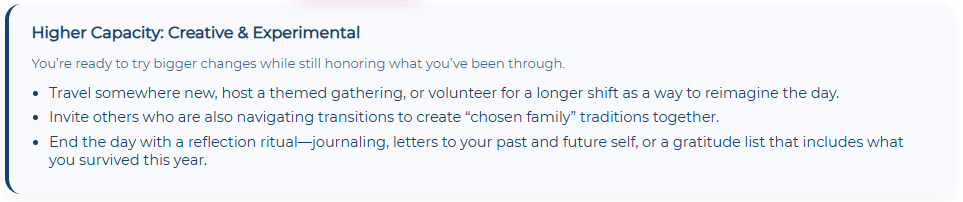
The first holiday season after a major life transition requires a different approach: experimentation without expectation. Try new activities knowing some will fall flat. Deliberately choose to spend the day differently than you ever have before—travel, volunteer, host a gathering with a chosen family who understand what you’re navigating.
Practical Strategies for Surviving the Holidays During Major Life Transitions
Adapt Your Reality to Match Your Capacity
You don’t owe anyone an explanation for doing the holidays differently.
If large family gatherings feel overwhelming: Host a small dinner with 2-3 people who genuinely understand what you’re experiencing. One single mother told us: “I stopped going to my ex’s family gatherings and started hosting ‘orphan Thanksgiving’ with other divorced friends. Best decision I ever made.”
If your home feels heavy with memories: Change your physical environment entirely when coping with change. Travel somewhere you’ve never been. Volunteer at a shelter where you can focus on helping others. As one recent widow shared: “I spent Christmas in Costa Rica. People thought I was running away. I was actually running toward rediscovering myself.”
If the expectation of cooking and hosting feels impossible: Rewrite the rules while navigating life transitions. Order takeout from three different restaurants and make it a tasting menu. Prepare one meaningful dish and make everything else store-bought. Host a potluck where everyone brings one item. These choices honor your capacity while still creating meaningful celebration.


Build Rituals That Speak to Your Specific Experience
What you need depends entirely on what you’re navigating. Match coping strategies to your reality:
For those adjusting to being single after divorce or relationship changes: Create a New Year’s Eve ritual that marks this transition deliberately. One divorced father created what he calls his “Year in Review” tradition: on December 31st, he writes three letters—one to his past self from January, one to his current self recognizing what he survived, and one to his future self with intentions for the new year.
If you’re navigating your first holiday after loss: Establish a memorial act that transforms grief into meaning while processing grief in a healthy way. Visit a place they loved and do something they would have enjoyed. One daughter created a “Dad would have loved this” photo album throughout December. “It kept him present without making everything about missing him.”
For career transitions or relocations: Use this time to explore your new identity or location deliberately when adjusting to life changes. If you’ve changed careers, host a gathering with new colleagues. If you’ve relocated, discover one new tradition in your new city each week—visit holiday markets, attend local events, try restaurants recommended by locals.
The Power of Community in Your New Reality
Building new traditions works better when you’re not doing it alone while navigating life transitions.
Children bring fresh perspectives that can lighten what feels heavy. One mother created a “new traditions brainstorming night” where her kids pitched ideas for what they wanted to do differently. “They came up with stuff I never would have thought of. And giving them agency helped them adjust too.”
Friends who’ve experienced similar transitions become chosen family who understand without requiring explanation when coping with change. They’re the ones who can say “This is hard” without following it up with “but at least…” They know because they’ve lived it.
Online communities offer 24/7 connection with people navigating similar major life changes. Sometimes you need emotional support at 2 AM when you can’t sleep. These communities share practical coping strategies you won’t find in articles—real tactics from real people who made it through.
Small Rituals Create Sustainable Change
What helps most people cope with change during the holidays isn’t making the big holiday days perfect. It’s small, regular rituals that provide structure without pressure.
Build weekly touchpoints throughout November and December: Sunday evening walks to view neighborhood lights. Weekly movie nights with films that bring comfort. Saturday morning coffee at a different café each week. Wednesday night video calls with that friend who actually asks how you’re doing and waits for the real answer. Monthly volunteer shifts at a local organization.
This approach to adjusting to life changes reduces anxiety because you’re building patterns that support your mental health rather than white-knuckling your way through one supposedly perfect day.
When Self-Help Isn’t Enough: Professional Support for Life Transitions
Signs You Need More Than Self-Help
Self-help has limits. Consider therapy if you’re experiencing:
- A therapist who specializes in navigating life transitions helps you unpack anticipatory anxiety about upcoming events.
- Set and maintain boundaries with family members who don’t understand what you need while coping with life transitions.
- Work through guilt about “moving on” or experiencing moments of happiness during the adjustment period. Processing the complicated truth that you can miss someone desperately and still laugh at a joke, that you can grieve your marriage and still enjoy being single.
- Develop practical coping strategies for triggering situations before they happen while processing grief.
- Therapy helps you notice when your internal dialogue becomes harsh and replace it with something more realistic and kind.
Beyond Therapy: Building Your Support Network
Grief support groups connect you with others who understand loss intimately. There’s something powerful about sitting in a room where you don’t have to explain why you started crying when someone mentioned Christmas cookies.
Online forums for specific transitions provide connection any time you need it. The value comes from posting your own struggles and from reading about others’ experiences and recognizing yourself in their stories.
The Self-Compassion Practice That Changes Everything
Every time you notice harsh self-talk—”I should be handling this better” or “Everyone else seems fine, what’s wrong with me?”—pause and ask yourself: Would I say this to someone I love who was going through what I’m going through?
The answer is almost always no. So, treat yourself with the kindness you’d offer someone you love during their adjustment period.
What You’re Building
Your holidays after significant life transitions will never look exactly like they did before. What you’re building now through navigating change has the potential to be deeply meaningful in ways that reflect who you’re becoming.
Creating new traditions while processing grief honors your experience by acknowledging your pain and your capacity to find connection again.
The coping strategies you develop now become life skills that make you more capable of handling whatever comes next.
You Don’t Have to Navigate This Alone
We offer accessible online therapy for major life transitions that fits your schedule and meets you where you are. No judgment. No pressure to be “better” faster. Just compassionate support from therapists who understand that navigating life transitions during the holidays requires strategy and grace.
Our team provides specialized support for:
- Grief and loss during the holidays and beyond
- Divorce and relationship changes that reshape your identity
- Career transitions and the identity shifts that come with them
- Relocation and major lifestyle adjustments
- Any life transition that’s making you question whether you’ll ever feel like yourself again
You deserve the same compassion you’d offer someone you love. You deserve support from someone trained to help people through exactly what you’re experiencing. You deserve to build a holiday season and a life that honors where you’ve been and where you’re going.
Take the Next Step
Additional Resources
National Institute of Mental Health (NIMH)

