
You’re scrolling through holiday photos again. Everyone’s posting about promotions, engagements, year-end wins. And you? You’re lying awake at 2 AM asking yourself: What did I actually do this year?
December questioning are different. It’s not just normal self-reflection—it’s that sinking feeling that everyone moved forward while you stayed stuck. That pressure to have something to show for the past twelve months. That voice asking if you’re on the right path, or any path at all.
Research shows nearly 41% of adults experience increased anxiety during the holiday season, and a 2021-22 study found that life satisfaction drops to its lowest point in December—even lower than during lockdowns.
Let’s talk about why December questioning feels so intense, how to tell when it becomes a problem, and what you can do to turn these heavy questions into real change.
Why December Questioning Happens: The Psychology Behind Year-End Life Evaluation
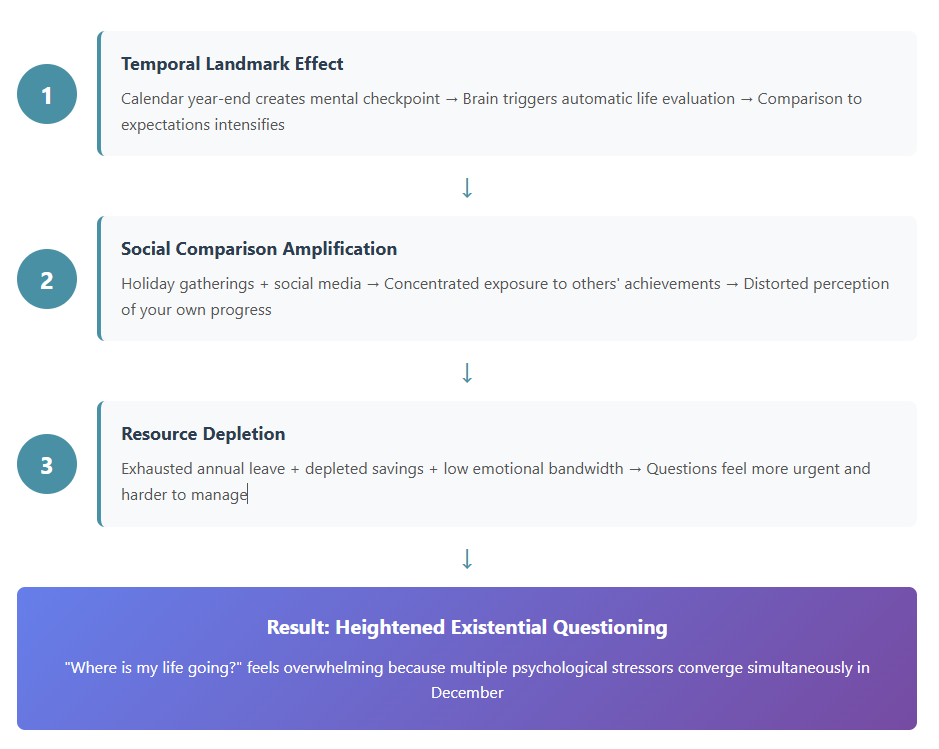
There are actual psychological reasons why this month makes us question everything. This isn’t bad on its own, year-end reflection can push you toward positive change. But when it combines with December overstimulation — the cumulative sensory, social, and emotional demands of the season — that helpful reflection can spiral into harsh self-judgment.
The Brain Sees December as a Finish Line
Psychologists call it the “temporal landmark effect.” Your brain uses major dates—birthdays, anniversaries, New Year’s Eve—as mental bookmarks to measure progress. December represents the end of an entire calendar year, making it one of the strongest temporal landmarks we experience.
Think about it: You don’t just think “another month passed.” You think “another year passed.” That distinction matters. It triggers automatic evaluation: Did I grow? Did I move forward? Am I where I thought I’d be?
This isn’t bad on its own. Year-end reflection can push you toward positive change. But when it combines with December’s other stressors, that helpful reflection can spiral.
Social Comparison Goes Into Overdrive
Holiday season = comparison season. You’re not just seeing one friend’s success—you’re seeing dozens of highlight reels compressed into a few weeks. Family gatherings become unofficial progress reports. Social media feeds overflow with “year in review” posts showcasing everyone’s best moments.
Your brain doesn’t care that these are highlight reels. It absorbs the comparison anyway. Suddenly you’re measuring your life against everyone else’s carefully curated updates. And the gap feels huge.
The Culture of Fresh Starts and Clean Slates
Our culture treats January 1st like magic. Ads promise transformation. People make grand resolutions. There’s pressure to have a story of “what went wrong” this year and a plan for “how you’ll fix it” next year.
But real life doesn’t work in calendar years. Growth is messy, non-linear, and often invisible. You might have made huge internal progress that doesn’t translate to external achievements. But December’s narrative demands visible proof.
You’re Running on Empty
By December, most people have burned through their vacation days, savings, and emotional reserves. The holidays add financial stress, family dynamics, and social obligations. This depletion makes existential questions feel more urgent and harder to manage.
When your resources are low, even small doubts become overwhelming questions.
Understanding these triggers won’t make the questions disappear. But it helps you see them for what they are: a predictable psychological response to a uniquely challenging time, not evidence that your life is off track.
When December Questioning Becomes Harmful: Knowing the Difference Between Reflection and Rumination
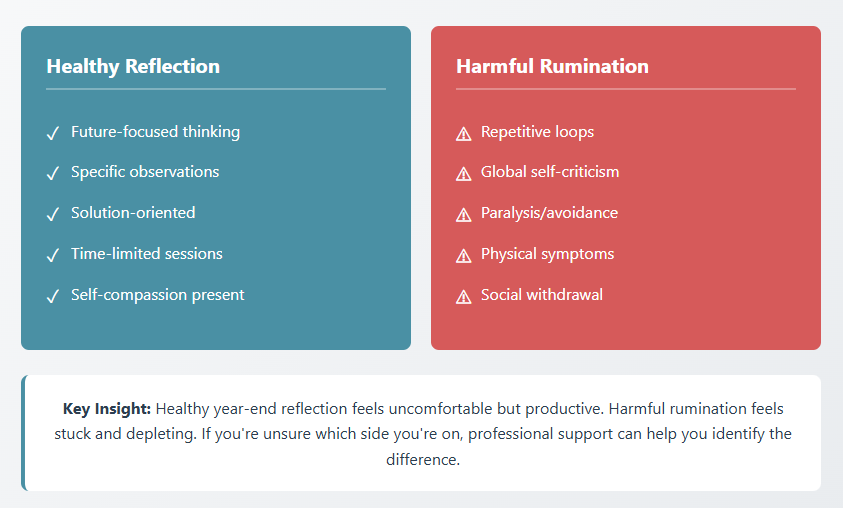
Not all questioning is equal. There’s healthy self-reflection that leads somewhere, and there’s rumination cycle that keeps you stuck.
What Healthy Self-Reflection Looks Like
When reflection serves you, it has these qualities:
You’re looking forward, not just backward. You’re thinking about what you want to change or try, not just replaying what went wrong.
You can get specific. You notice patterns or situations you want to address, rather than making sweeping judgments about your worth as a person.
You come away with possibilities. Even if they’re small, you have ideas about next steps or things to explore.
It has boundaries. You think things through, then move on with your day. The thoughts don’t follow you everywhere.
You treat yourself with compassion. You acknowledge disappointments without cruelty. You can say “this was hard” without adding “because I’m a failure.”
Healthy reflection might feel uncomfortable, but it’s productive. You gain clarity about your values, priorities, or what needs to shift.
Warning Signs That You’ve Crossed Into Rumination
December questioning becomes concerning when you notice:
The same thoughts on repeat. You ask yourself the same questions over and over without reaching new insights or conclusions.
Everything becomes proof you’re failing. Your thoughts include words like “always” and “never.” One disappointment becomes evidence of a pattern of failure.
You can’t take action. The questioning itself prevents you from making decisions or taking steps forward. You’re frozen.
Your body is telling you something’s wrong. Sleep disruption, appetite changes, persistent fatigue, tension that interferes with daily functioning.
You’re pulling away from people. Avoiding friends, family, or activities because the comparison or conversation feels too painful.
You can’t find a single positive. When someone asks about good moments from the year, your mind goes completely blank. You genuinely can’t identify anything that went well.
When to Reach Out for Professional Support
If your December questioning includes thoughts that life isn’t worth living, that you’re worthless, or wondering if anyone would notice if you disappeared, reach out for help immediately. These thoughts signal you’re dealing with more than typical year-end stress.
Similarly, if the rumination is interfering with your ability to work, maintain relationships, or care for yourself, therapy can help you break the cycle and address what’s underneath.
From Questions to Action: Building a Compassionate Plan That Honors Where You Are
Once you understand why December triggers these questions and can recognize healthy versus harmful patterns, the next step is creating a path forward.
Ask Better Questions
“Where is my life going?” is too big and too vague to answer. It leads to paralysis. Try these instead:
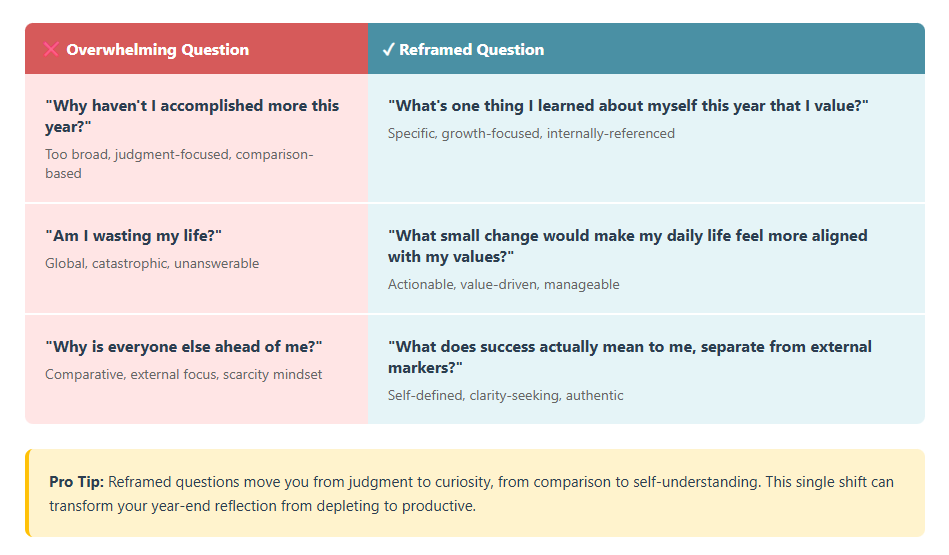
These questions shift you from judgment to curiosity. From comparison to self-understanding.
Measure Against Your Own Values, Not External Markers
Stop using other people’s highlight reels as your measuring stick. Try this instead:
List your core values. What actually matters to you? Connection, creativity, growth, stability, adventure, contribution, authenticity—identify 3-5 that resonate.
Count efforts, not just outcomes. Growth includes attempts that didn’t work out, risks you took, and days you simply survived difficult circumstances.
This removes the all-or-nothing thinking that makes December questioning so painful. You’re not behind or ahead—you’re on your own timeline, making choices based on what matters most to you.
Create Micro-Goals, Not Life Overhauls
If your December questioning reveals areas where you want change, resist massive transformation plans. Instead:
Pick one specific area. Something manageable, like “explore career options that use my creativity” rather than “completely change careers by March.”
Build in accountability. Share your goal with someone supportive, or work with a therapist who can help maintain momentum and work through obstacles.
Practice “Good Enough” Living
One of the most powerful shifts: embracing that your life doesn’t need to be perfect or Instagram-worthy to be meaningful. Most days, you’re doing better than you think.
Try these daily practices:
Evening “wins” reflection. Before bed, identify three things that went okay or better today. They can be tiny. You got out of bed. You drank water. You were kind to someone.
Comparison detox. Take breaks from social media when it fuels comparison rather than connection. Your December questioning will quiet down when you’re not constantly measuring yourself against others’ highlights.
Know When to Get Professional Support
Sometimes, despite your best efforts, you need outside help to move from questioning to clarity. Therapy isn’t just for crisis moments. It’s for times when you’re feeling stuck, uncertain, or need a skilled guide for life transitions.
A therapist can help you:
- Identify thought patterns that keep you stuck in December questioning
- Build personalized strategies for managing anxiety and rumination
- Explore deeper questions about purpose, identity, and direction in a safe space
- Develop decision-making skills that align with your authentic self
- Process past experiences that may influence your current uncertainty
At Insight Therapy Solutions, we believe everyone deserves accessible, compassionate support. Our therapists have experience helping clients work through existential questions, life transitions, and the anxiety that often comes with uncertainty about the future.
Moving Forward With December Questioning
The fact that you care about living a meaningful life is evidence you’re already on a path worth walking.
The key is learning to distinguish between reflection that serves you and rumination that depletes you. Then take small steps toward the life you want to create.
- You don’t need everything figured out by January 1st.
- You don’t need to match anyone else’s timeline.
- You simply need to honor where you are right now while gently moving toward where you want to be.
Your life is unfolding as it should, even when it doesn’t feel that way. And you don’t have to work through these questions alone.
Book your 15-minute free Therapist Matchmaking Session today and let us help you find the right therapist who understands your needs. Together, we’ll help you transform December questioning into clarity and move from uncertainty to meaningful action.
You deserve support. You deserve compassion. And you deserve a life that feels authentically yours.

