
Cognitive and behavioral therapies are designed to help people break out of mental loops—but if you’ve ever found yourself asking, “Why do I keep ending up here?”, you’re not alone. The same worries, the same reactions, the same emotional spirals can repeat, even when you know better.
Maybe it’s the anxiety that shows up every Sunday night before the work week. Or the way you shut down during conflict, even though you’ve promised yourself you’ll speak up next time. Or how you keep overcommitting to things you don’t actually want to do, then resenting yourself for saying yes again.
Mental loops can feel frustrating and exhausting, especially when insight alone doesn’t seem to move the needle. You understand what’s happening. You can trace it back to where it started. But somehow, that awareness doesn’t translate into doing things differently.
Why Mental Loops Form and Why They’re So Hard to Break
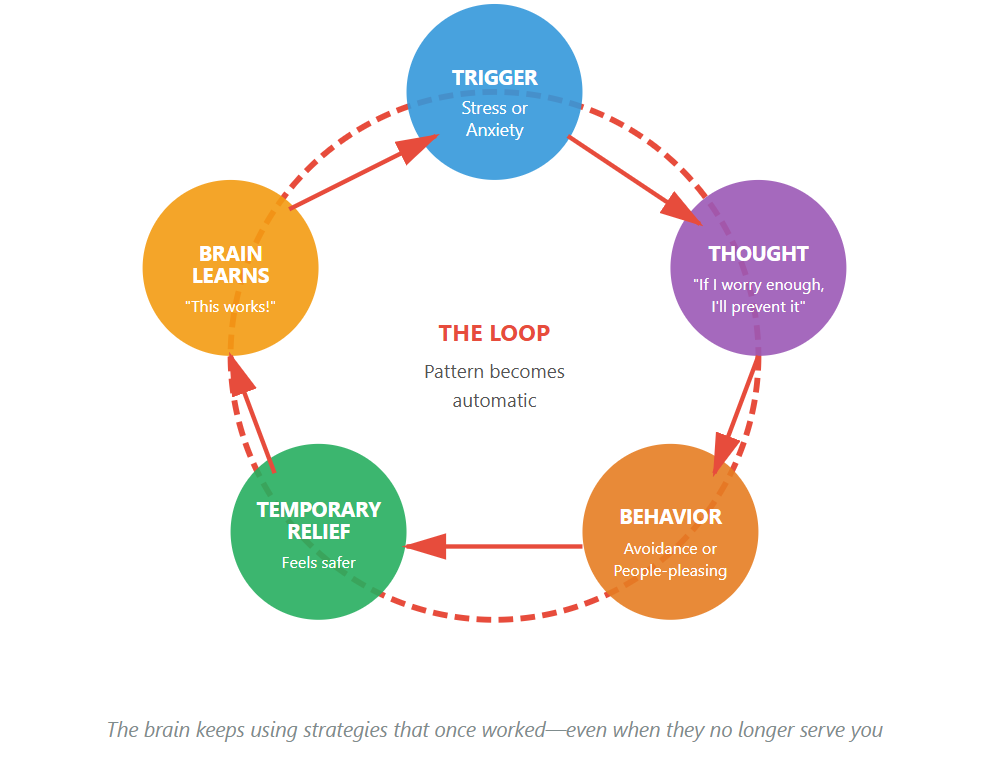
Mental loops don’t appear out of nowhere. They develop as the brain’s way of coping with anxiety, chronic stress, and unresolved experiences, especially when those experiences taught you that certain thoughts or behaviors once helped you feel safer or more in control.
Over time, the brain learns patterns like: If I worry enough, I’ll prevent something bad. Or If I avoid this feeling, it won’t overwhelm me. Or If I people-please, I won’t be rejected.
This is why insight alone often isn’t enough. You can understand exactly why you react the way you do and still find yourself reacting the same way. You might know your perfectionism comes from growing up in a critical household, but that knowledge doesn’t automatically stop you from staying up until 2 a.m. redoing a work presentation that’s already good enough.
Rumination cycles run on autopilot because they’ve been practiced so many times. Interrupting them requires more than awareness. It requires new skills and deliberate practice.
Breaking mental loops requires learning new ways to respond and that is something cognitive and behavioral therapies are specifically designed to support.
How Cognitive and Behavioral Therapies Interrupt the Thought–Emotion–Behavior Cycle
Cognitive and behavioral therapies focus on what happens between your thoughts, emotions, and actions.
Here’s how they work in practical terms:
First, you learn awareness without overwhelm. This means noticing thoughts and emotional reactions as they happen, without immediately getting pulled into them or needing to fix them right away. It’s the difference between “I’m having the thought that I’m going to fail” and “I am going to fail.”
Second, cognitive and behavioral therapies emphasize skill-building over insight alone. You work on tools you can actually practice, like emotion regulation, cognitive reframing, grounding techniques, and values-based decision-making. These aren’t abstract concepts. They’re things you can use at work, in relationships, during conflict, or when stress hits hard.
Third, there’s a strong focus on real-life application. The goal of cognitive and behavioral therapies isn’t just understanding patterns, It’s being able to use what you’ve learned when your boss emails you at 9 p.m., when your partner says something that triggers you, or when anxiety shows up uninvited on a random Tuesday afternoon.
Different Types of Cognitive Behavioral Therapy
While CBT is often talked about as one approach, there are actually several variations designed to meet different needs. All forms of Cognitive and Behavioral Therapies share the same core idea — that our thoughts, emotions, and behaviors are connected — but they may emphasize different skills or techniques.
Some common types include:
Standard CBT
This is the traditional, structured approach focused on identifying unhelpful thought patterns and replacing them with more balanced, realistic ones while also practicing new behaviors.
Trauma-Focused CBT (TF-CBT)
Specifically designed for individuals who have experienced trauma, this version helps process painful memories while building coping skills and emotional regulation.
Exposure-Based CBT
Often used for anxiety, OCD, and phobias, this approach gradually and safely helps individuals face feared situations so the brain can learn that they are manageable.
Dialectical Behavior Therapy (DBT)
Originally developed for intense emotional dysregulation, DBT incorporates CBT principles while adding skills in mindfulness, distress tolerance, and emotional regulation.
Acceptance and Commitment Therapy (ACT)
Rather than trying to change thoughts directly, ACT helps individuals relate differently to their thoughts while committing to actions aligned with their values.
No matter the variation, these approaches are practical, skill-based, and focused on helping individuals interrupt unhelpful patterns and build healthier ones.
What Real Change Looks Like When You Practice New Skills Consistently
One of the biggest misconceptions about therapy is that change should feel dramatic, like a light switch flipping or a sudden “aha” moment that rewrites everything. In reality, progress often looks quieter and more sustainable.
Real change usually shows up as pausing before reacting instead of responding automatically. It’s noticing a thought without immediately believing it. It’s feeling discomfort without needing to escape it right away. It’s making choices that align with your values, even when emotions are pulling you in another direction.
These shifts happen through repetition and each time you practice a skill, inside or outside the therapy room, you’re teaching your brain a new option. The first few times, it might feel clunky or forced, but over time those new responses become more familiar and accessible.
Progress with cognitive and behavioral therapies is rarely linear. Slipping back into old habits doesn’t mean therapy isn’t working, which means your brain is learning a new way to respond.
A Supportive Path Forward
At Insight Therapy Solutions, our licensed therapists specialize in cognitive and behavioral therapies that help people break out of mental loops and build practical tools for everyday life. Therapy isn’t about fixing you—it’s about giving you strategies that fit who you are and what you’re facing right now.
Whether you’re struggling with anxiety, stress, emotional overwhelm, or patterns that keep repeating no matter how much you try to change them on your own, support can make a meaningful difference.
Conclusion: Change Happens Through Practice, Not Perfection
Mental loops are learned patterns and learned patterns can be unlearned. With the right support and consistent practice, it’s possible to respond to thoughts and emotions differently, even when they feel intense or familiar.
You don’t have to wait for a breakthrough to start changing. Small, repeated steps are often what lead to the biggest shifts over time. Progress doesn’t always feel like progress in the moment, but when you look back, you’ll notice the difference.

Additional Resources:
American Psychological Association (APA)
Evidence-based overview of Cognitive Behavioral Therapy, how it works, and what research shows.
National Institute of Mental Health (NIMH)
Clear explanations of anxiety, thought patterns, and how behavioral therapies are used in treatment.
Association for Behavioral and Cognitive Therapies (ABCT)
Practical, clinician-reviewed resources explaining CBT, DBT, ACT, and skill-based therapy approaches.
Disclaimer
This guide is for educational purposes only. It is not intended to diagnose, recommend specific treatment, or replace professional care. Personal treatment decisions should always be made in consultation with a licensed mental health provider who can consider your individual circumstances.

