
We spend so much time asking ourselves if we’re doing enough.
Am I successful enough? Productive enough? Happy enough? Healing fast enough?
At Insight Therapy Solutions, we sit across from accomplished, capable people every single day people who’ve checked all the boxes society told them mattered and we hear the same quiet confession:
“I thought I’d feel different by now. I thought achieving all this would make me feel… better. But I still feel empty.”
Which raises an uncomfortable question we think more people need to ask: What if our entire framework for evaluating a “good life” is fundamentally broken?
Why the Traditional Idea of a “Good Life” Leaves So Many People Feeling Behind
Let’s be honest about what we’ve been taught to value.
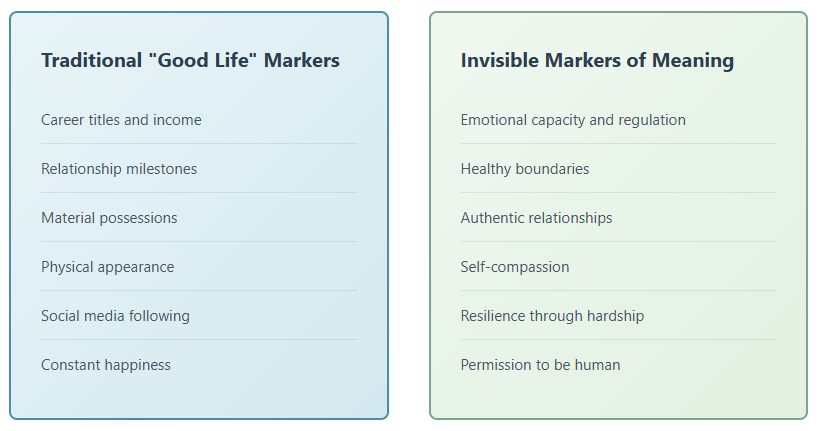
A “good life” is supposed to include:
- Career success (titles, income, recognition, upward trajectory)
- Relationship milestones (marriage, children, the “right” partnerships)
- Material markers (the house, the car, the aesthetic life)
- Physical appearance (youth, fitness, conventional attractiveness)
- Social proof (popularity, influence, being chosen and celebrated)
- Constant happiness (or at least the performance of it)
We’ve inherited a checklist that treats life like a project to be completed. Hit these benchmarks, display these achievements, and you’ll have earned the right to feel good about yourself.
But here’s what that framework completely misses: the entire emotional reality of being human.
We’ve absorbed productivity culture so deeply that we evaluate our existence the way we’d evaluate a business plan. We measure outputs and we compare our behind-the-scenes to everyone else’s highlight reel and wonder why we feel inadequate.
And social media hasn’t just accelerated this, it’s made it inescapable. Every day, our feeds flood with curated evidence of other people’s “good lives”: the promotions, the adventures, the aesthetically perfect moments, the transformation posts.
Even when we know intellectually that these are edited snapshots we still internalize the comparison.
The result? We judge our complex and fully-dimensional life against everyone else’s carefully edited trailer.
We set goals based on who we think we should become rather than who we actually are. We chase benchmarks that were never ours to begin with. We achieve what we thought would make us happy, only to discover that accomplishment and fulfillment are not the same thing.
The traditional benchmarks for a “good life” are external, quantifiable, and comparative. They exist on resumes and Instagram grids.
But the experiences that actually make life feel meaningful? Those are often invisible.
The Invisible Markers of a Meaningful Life You’re Probably Overlooking
We want to tell you about some of the “good lives” we’ve witnessed in our practice, the ones that would never show up on social media.
We’ve watched someone spend years learning to quiet the cruel voice in their head. Slowly, painfully, rewiring decades of internalized shame until they could finally look in the mirror without disgust.
On paper? Nothing changed. Same job. Same body. Same circumstances.
In reality? They rebuilt their entire relationship with themselves. They stopped treating themselves like an enemy to be punished and started treating themselves like a person deserving of compassion.
That’s a good life.
People who walked away from the “impressive” life they built because it was slowly killing them and chose themselves over everyone’s expectations.
They might have lost the approving nods, but they also gained the ability to breathe and feel like themselves again.
That’s a good life.
We’ve worked with people who’ve simply learned to be with their own emotions—to feel anger without exploding, sadness without spiraling, anxiety without running. Who’ve stopped numbing, bypassing, and performing their way through existence and they became real, present and human.
That’s a good life.
Here are some of the invisible markers of a meaningful and good life we wish more people celebrated:
Boundaries that exist, even imperfectly: You’ve learned that “no” is a complete sentence, and you choose your peace over performing endless availability.
Relationships that are honest: You’ve let go of connections that required you to be smaller, quieter, or less than you are. You’ve chosen depth over performance.
Resilience built through surviving: You lived through seasons that almost broke you, and you’re still here. You endured what you didn’t think you could endure. You proved to yourself that you’re stronger than you knew because you kept going even when you felt fragile.
The courage to disappoint people: You’ve started living your life instead of the one everyone else wanted for you. You’ve let people be upset with your choices. You’ve prioritized your own wellbeing even when it made you the “difficult” one.
Permission to be human: You’ve stopped treating rest like something you have to earn. You’ve accepted that you have limits. You’ve let go of the idea that you should be able to do it all, have it all, be it all—all while looking effortless.
These are the things that actually change your life.
These are the things that determine whether you feel connected to yourself and your life, or whether you’re just performing your way through existence while feeling increasingly hollow inside.
How to Redefine a “Good Life” in a Way That Fits Your Reality
So how do we break free from the toxic productivity framework and create a more honest, more human way of living?
It starts with getting real about what actually matters to you and what genuinely makes your life feel meaningful.
Ask Better Questions
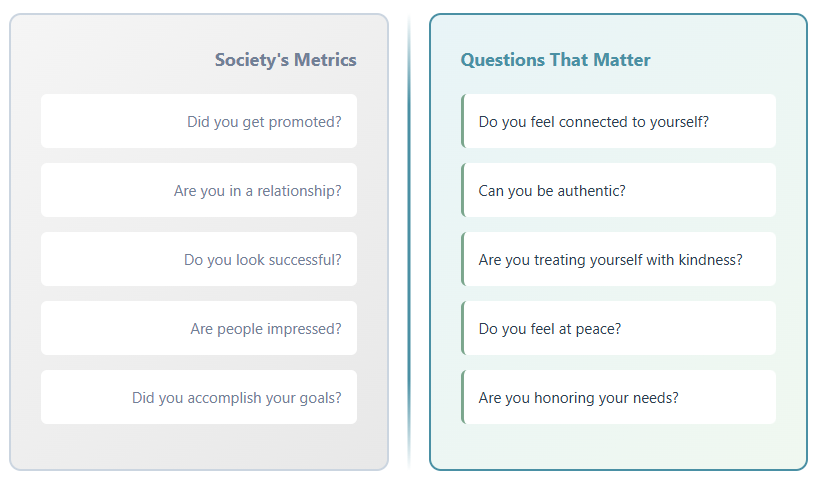
Instead of “Am I successful enough?” try these:
About presence: When do I feel most alive? Most like myself? What moments make me think, “This—this is what I want my life to feel like”?
About values: What do I do that feels aligned with who I actually am? What am I doing only because I think I “should”? If no one was watching or judging, what would I choose?
About relationships: Which connections leave me feeling more myself, not less? Where do I feel seen, not just admired? Who can I be real with?
About growth: What do I understand about myself now that I didn’t before? What patterns have I started to recognize? How have I changed in ways that aren’t visible from the outside?
About peace: What helps me feel grounded? What lets me breathe deeper? What makes me feel safe in my own body and mind?
Notice how different these questions feel from “What have I achieved?” They’re asking about inner experience and not external validation.
Honor Your Actual Capacity
Not every season is a building season. Not every phase is about growth in the upward-trajectory sense.
Some seasons are for surviving. Some are for resting. Some are for processing grief or integrating loss. Some are for burning down what no longer serves you and sitting in the ashes before you rebuild.
We’ve been conditioned to believe life should be constant progress, but that’s not how humans work. That’s not even how nature works.
What if you stopped judging yourself for being in the season you’re actually in?
If you’re in survival mode, success looks like making it through. If you’re healing from trauma, success looks like showing up to do the work. If you’re rebuilding after loss, success looks like taking tiny steps forward. If you’re finally resting after years of burning out, success looks like not apologizing for it.
Redefine What Success Means to You
Try completing these prompts, honestly, without performing for an imaginary audience:
I feel most like myself when…
Something I do that makes my life feel meaningful is…
A choice I’ve made that I’m genuinely proud of is…
Something about my life that doesn’t look impressive but matters deeply to me is…
If I could design my life around one feeling, it would be…
This is your life. Not the performative version. Not the one that gets applause. The real, messy, complex version that you actually have to live in.
What if you started measuring it by whether it feels true to you, rather than whether it looks successful to everyone else?
A Final Reflection
A good life is measured by whether you stayed connected to yourself. Whether you treated yourself with humanity. Whether you honored your actual needs instead of performing endless capability. Whether you let yourself be fully human—messy, imperfect, tired, trying, and enough exactly as you are.
A good life is one where you survived what you needed to survive. Felt what you needed to feel. Set boundaries when you need space. Asked for help when you needed support. Choose authenticity over approval, even when it costs you something.
A good life is one where you were real.
And if life feels hard right now—if you haven’t accomplished what you thought you would, if you’re just trying to keep your head above water, if you feel behind everyone else, we want you to know something:
You’re already living a life that matters.
Not because of what you’ve achieved, but because of who you are. Not because you’ve earned it through productivity, but because you’re a human being worthy of compassion, rest, and peace.
The only thing that needs to change is the impossible standard you’ve been measuring yourself against.
You don’t need to fix yourself and you need to stop judging yourself by metrics that were never designed for your humanity.
Additional Resources
Positive Psychology
Resource: How to Live the Good Life
This article explores research-backed perspectives on what makes life meaningful, emphasizing values, relationships, and psychological well-being rather than external achievement or constant happiness.
Harvard Graduate School of Education
Resource: On Edge: Understanding and Preventing Youth Mental Health Challenges
This report examines the broader emotional pressures shaping modern life, including stress, disconnection, and expectations—offering context for why many people struggle to feel satisfied even during objectively “successful” periods.

